What Is Nail Clubbing?
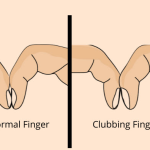
Nail clubbing (also called digital clubbing) is a structural change of the fingernails and fingertips characterized by:
- Bulbous enlargement of the distal finger
- Increased curvature of the nail plate
- Softening of the nail bed
- Loss of the normal angle between the nail and cuticle (Lovibond angle)
Normally, the angle between the nail plate and proximal nail fold is about 160°.
In clubbing, this angle exceeds 180°.
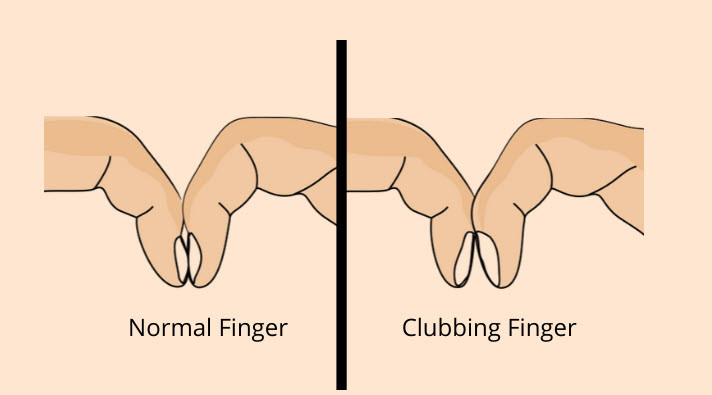
How to Check: The Schamroth Sign
One simple clinical test is the Schamroth window test:
- Place the same fingers from each hand nail-to-nail.
- Look for a small diamond-shaped space between the nails.
- If the space is missing, clubbing may be present.
This is often one of the earliest bedside clues.
Why Does Nail Clubbing Happen?
The exact mechanism is still being studied, but leading theories include:
- Chronic hypoxia (low oxygen levels)
- Increased vascular endothelial growth factor (VEGF)
- Platelet-derived growth factors reaching the nail bed
- Increased blood flow and connective tissue proliferation
Clubbing is usually not a nail disease itself — it is often a sign of an underlying systemic condition.
Conditions Associated with Nail Clubbing
🫁 Lung Conditions
- Lung cancer
- Interstitial lung disease
- Cystic fibrosis
❤️ Heart Conditions
- Congenital heart disease
- Infective endocarditis
🦠 Gastrointestinal / Liver Conditions
- Inflammatory bowel disease
- Cirrhosis
In some cases, clubbing can be idiopathic (no identifiable cause), but that is less common.
When Should Someone See a Doctor?
If nail clubbing appears:
- Suddenly
- Along with shortness of breath
- With chronic cough
- With unexplained fatigue
It warrants medical evaluation.